Chemical equilibrium 01Chemical equilibrium #Kc6Choose the best answerFor N₂(g) + 3H₂(g) ⇌ 2NH₃(g), Qc < Kc. What change occurs as equilibrium is restored?A[NH₃] decreases and [N₂], [H₂] increaseB[NH₃] increases and [N₂], [H₂] decreaseCForward and reverse rates both become zeroDReactant and product concentrations become equal Like 0 Discuss 0Share
Chemical equilibrium 01Chemical equilibrium #Kc7Choose the best answerWhich statement correctly relates Kc to the equilibrium composition?ALarge Kc → mostly reactantsBSmall Kc → mostly productsCModerate Kc → appreciable amounts of both reactants and productsDKc = 1 → reaction is necessarily complete Like 0 Discuss 0Share
Chemical equilibrium 01Chemical equilibrium #Kc8Choose the best answerWhat does the value of Kc mainly tell us about an equilibrium reaction?ARate and activation energy of the reactionBDirection and extent of the reaction at equilibriumCTime required to reach equilibriumDEffect of a catalyst on equilibrium position Like 0 Discuss 0Share
Chemical equilibrium 01Chemical equilibrium #Kc9Choose the best answerFor a reversible reaction at equilibrium, how is Kc related to the forward and reverse rate constants?AKc = kr/kfBKc = kf + krCKc = kf/krDKc = kf × kr Like 0 Discuss 0Share
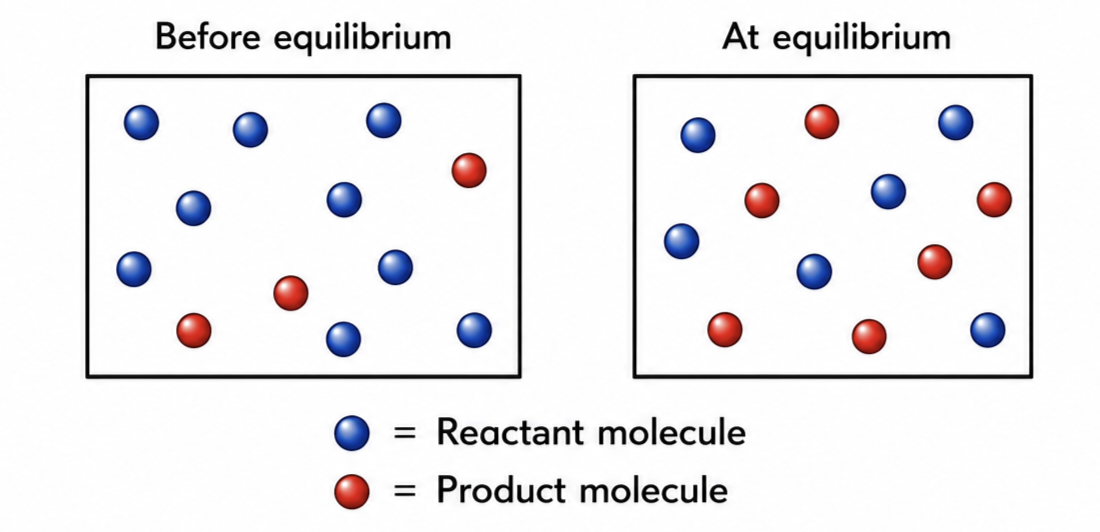
Chemical equilibrium 01Chemical equilibrium #Equilibrium Constant10Choose the best answerThe diagrams represent a reversible reaction at equilibrium in a closed container. Which statement describes this state correctly?AOnly the forward reaction is occurringBOnly the reverse reaction is occurringCForward rate equals reverse rateDThere are more reactant molecules than product molecules Like 0 Discuss 0Share