Chemical KineticsInstantaneous and Average Rate16Choose the best answerThe average rate approaches the instantaneous rate when the time interval:ABecomes very largeBBecomes negativeCApproaches zeroDBecomes exactly one second Like 0 Discuss 0Share
Chemical KineticsVariation of Reaction Rate with Time17Choose the best answerFor a typical reaction in which reactant concentrations decrease with time, the reaction rate generally:AIncreases continuouslyBDecreases as the reaction proceedsCAlways remains constantDBecomes infinite Like 0 Discuss 0Share
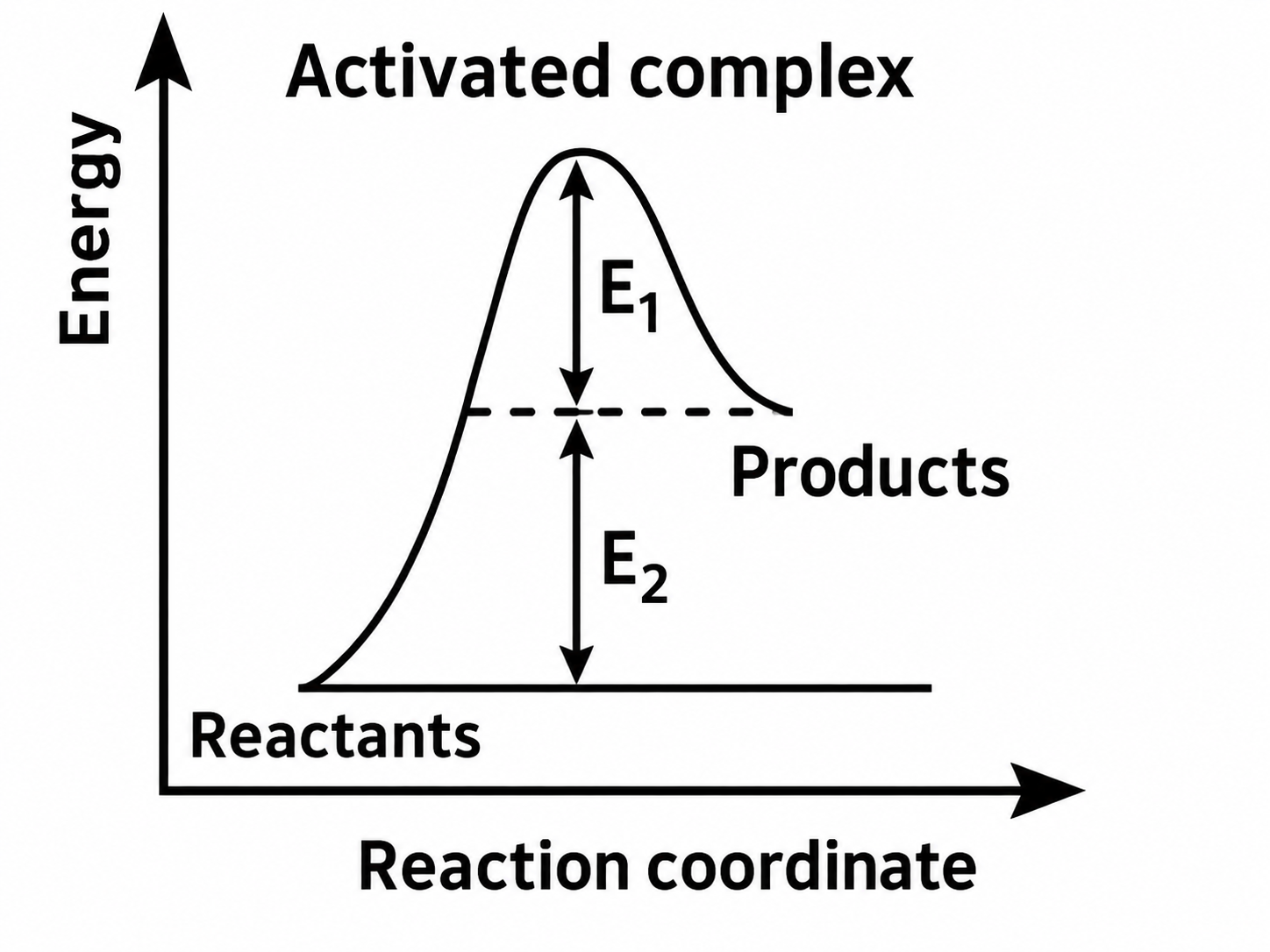
XiMDCAT XI Complete Chemistry Grand Test#Activation Energy#Chemical Kinetics18Choose the best answerWhich statement is correct for the energy-profile graph shown?AThe activation energy of the forward reaction is E₁ + E₂ and the product is more stable than the reactant.BThe activation energy of both forward and backward reactions is E₁ + E₂ and the reactant is more stable than the product.CThe activation energy of the backward reaction is E₁ and the product is more stable than the reactant.DThe activation energy of the forward reaction is E₁ + E₂ and the product is less stable than the reactant. Like 0 Discuss 0Share
Chemical kinetics #Rate Constant19Choose the best answerWhich statement about the rate constant, k, is correct?AIt is independent of temperature.BIt depends only on the initial concentration of reactants.CIts value changes with temperature but not with reactant concentration.DIt is equal to the reaction rate. Like 0 Discuss 0Share
Chemical KineticsEffect of Concentration on First-Order Reaction20Choose the best answerA gaseous reaction is experimentally first order overall. If the vessel volume is reduced to one-third at constant temperature, the reactant concentration becomes three times larger. The reaction rate therefore becomes:AOne-third as largeBTwo-thirds as largeCThree times as largeDSix times as large Like 0 Discuss 0Share